
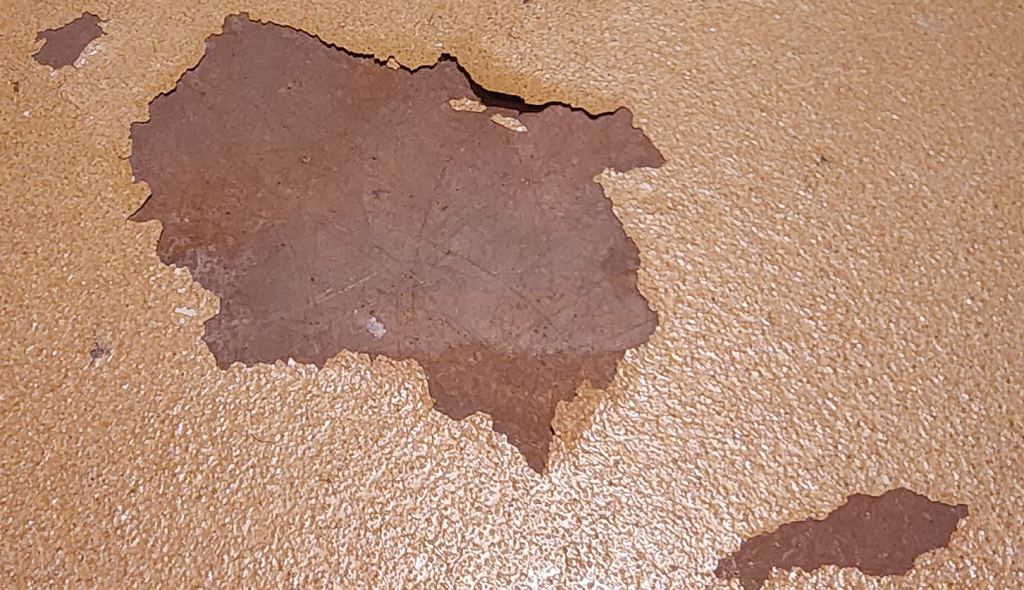
There are two dominant ways a coating can hold on to a surface. Most coatings grip it mechanically. A smaller category of coatings bonds to it chemically. The difference in those two mechanisms — how each one works, how each one fails, and what it costs to maintain a floor over time — is the difference between two entirely different categories of coating system.
This is not a nuance. It determines the maintenance protocol, the failure pattern, and the total cost of protection over the life of a facility.
How mechanical adhesion works
Mechanical adhesion is the dominant mechanism in most conventional coating systems — epoxy, urethane, most acrylic and polyurethane products. The coating is applied to a prepared surface and cures into a film that is physically keyed into the surface texture and pores. It grips.
The strength of that grip depends on two things: the condition of the substrate and the quality of the surface preparation. The surface has to be clean, free of contamination, at the right texture profile for the specific system, and dry enough that moisture vapor is not actively pushing upward through the slab. When all of those conditions are met, a mechanically bonded coating can perform well for years.
When any of those conditions are not met — oil or silicone contamination in the surface, a profile that is too smooth for the coating, a curing compound left from the original pour, elevated moisture vapor emission — the mechanical grip is compromised at the interface before the coating is even fully cured. The failure is built in from the start.
This is the primary reason mechanically bonded coatings fail: inadequate surface preparation. Not product failure. Not installation error in the conventional sense. The surface the mechanical grip was supposed to lock into was not ready to hold it.

How mechanical adhesion fails
When the interface holding a mechanically bonded coating gives way, the failure pattern is recognizable. It typically starts at the edges — where the bond is thinnest, where moisture can most easily get behind the film, and where thermal expansion and contraction create the most movement. Edges lift. Water infiltrates behind the film. Delamination spreads inward.
The rate at which this happens depends on the conditions the floor faces. High traffic accelerates it. UV exposure degrades the bond in exterior or high-light-exposure applications. Moisture vapor pressure from below — which is present in any concrete slab to some degree — continuously stresses the interface from beneath. Thermal cycling, as the floor expands and contracts through daily and seasonal temperature changes, works the bond repeatedly over time.
Even a well-prepped, correctly applied mechanically bonded coating is working against these forces continuously. When it eventually fails, it typically fails at the interface — in the zone between the coating and the substrate — not through the coating material itself. Remediation almost always requires removing the failed coating, re-prepping the substrate, and starting over.
How covalent bonding works
Covalent bonding is a different mechanism. Rather than physically keying into a prepared surface, a covalently bonded coating forms molecular-level chemical bonds with the substrate — reactive groups in the coating chemistry share electrons with compatible groups on the surface. The connection is chemical, not physical. The coating and the substrate are joined at the interface rather than in contact with it.
In chemistry, a covalent bond is a strong primary intramolecular bond — formed within a structure, by shared electrons — as distinct from the weaker intermolecular forces, such as hydrogen bonding or van der Waals forces, that act between separate molecules. These bonds require significant energy to break, substantially more than the forces that typically overcome a mechanical grip.
This is not a question of one being stronger in some absolute sense. It is a question of what the bond is subject to. Mechanical grip fails when the forces acting on the interface exceed the adhesion — and those forces are always present. A covalent bond changes the nature of the connection at the interface, which changes how it responds to moisture, thermal movement, and surface chemistry.
How covalent bonding fails — and why it matters
A properly applied covalently bonded coating is designed to wear gradually under high-traffic conditions rather than fail suddenly at the interface. Wear presents as surface abrasion — visible and gradual — rather than the edge-lift, bubbling, and delamination that characterize mechanical bond failure.
This distinction matters for maintenance. When a mechanically bonded coating shows signs of failure, the response is typically strip and recoat: mechanical removal back to bare substrate, re-prep, and reapplication. The cycle is expensive in both material cost and facility downtime, and it puts the floor back at square one — relying on fresh mechanical adhesion to a substrate that has now been through one failure cycle.
When a covalently bonded coating shows surface wear, the maintenance protocol is different: clean and recoat. A fresh coat applied directly over the existing one, without stripping, because the covalent bond to the substrate is still intact. The surface is worn. The foundation is not.
This is the practical difference between the two mechanisms. It is not that one lasts forever and the other does not. It is that they wear differently, fail differently, and require different responses when they do.

Where Coval sits in this picture
Coval Technologies takes its name from covalent bonding. The topical coatings in the Coval range — Concrete Coat, PCS, Stone Coat, UTC, Metal Coat, and related products — are formulated as a hybrid of modified organic resin covalently bonded within inorganic oxides, creating an integrated lattice matrix. Depending on the product and substrate, reactive groups in the coating can form covalent bonds with available surface groups on concrete, stone, metal, tile, or vinyl.
The practical result is a high cross-link density both within the coating matrix and at the substrate interface — which is what drives performance in internal comparative testing to 9H pencil hardness (ASTM D3363), the top of the scale, versus H to 2H for conventional polymer coatings. That cross-link density also means the coating is harder and more resistant to abrasion from above, and the attachment is more resistant to the forces that can separate a mechanically bonded coating from its substrate.
A clarification worth making: this applies to Coval’s topical covalent bond coatings specifically. The Coval range also includes primers, densifiers, and sealers that use mechanical adhesion, penetration, or a combination of both. Those are different products for different applications — the right system depends on the substrate, the conditions, and what the surface needs to do. The comparison above is not a categorical dismissal of mechanical adhesion. It is an explanation of why the bonding mechanism matters, and why a topical coating that bonds covalently to the substrate behaves differently from one that grips it.
What to take from this
Two facilities can have the same floor, the same traffic, the same cleaning protocols, and completely different coating outcomes — not because of the product, but because of the mechanism. A mechanically bonded coating in high-moisture-vapor conditions is under stress from below from day one. A covalently bonded coating in those same conditions forms its attachment at a different level and responds differently to the same forces.
The specification question is not just which coating to use. It is what bonding mechanism is appropriate for the substrate conditions, the performance expectations, and the maintenance model the facility operates on. The mechanism determines the outcome.
To discuss system selection for a specific substrate or environment: sales@covaltechnologies.com | USA: +1 281-566-4277 | Singapore: +65 9028 9174 | UAE: +971 54 588 11 77