
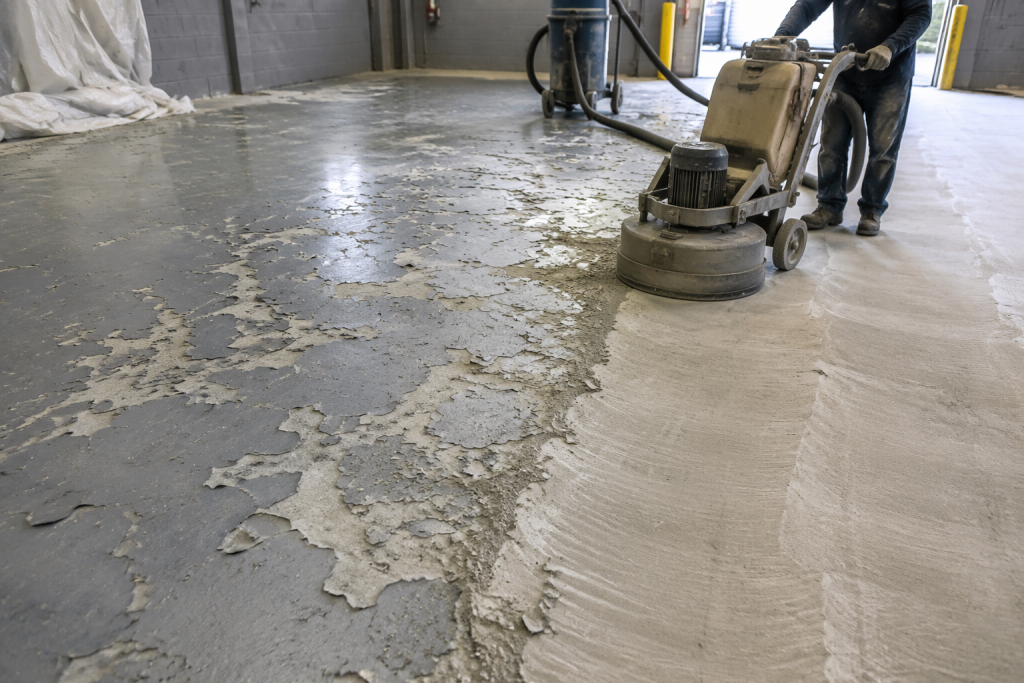
Walk into almost any warehouse, retail floor, or parking structure a few years past its last coating job, and you’ll often see the same story: dulling in high-traffic lanes, hairline peeling at joints and edges, dark staining where oil, salt, or cleaning chemicals have worked their way through. Many facility managers treat this as inevitable wear. In most cases, it is preventable, and the root causes almost always come down to two things: the quality of the surface preparation, and the nature of the bond between coating and substrate.
Why surface prep is the real make-or-break
Even a premium coating will underperform, or fail outright, if the surface beneath it isn’t properly prepared. This is the most consistently overlooked variable in flooring decisions, and it sets the ceiling for everything that follows.
The right preparation protocol depends on the substrate and the coating system being applied. For polished concrete specifically, proper preparation means densification before sealing. Densifying the concrete fills and hardens the capillary pores in the surface, strengthening the slab and creating a more consistent substrate for the coating to bond with. Skipping this step, or doing it improperly, leaves a porous and inconsistent surface that no sealer, however good, can fully compensate for.
It is worth noting that densification is not a universal pre-requisite. Many sealer systems rely on a degree of surface porosity to achieve proper bond — particularly where the concrete has not been ground prior to application. Applying a densifier before these systems can actually work against adhesion. The preparation protocol should always be matched to the specific system being applied.
Surface cleanliness matters more than most applicators acknowledge. Oils, residual waxes, silicone contamination, and even the wrong type of residual cleaner can all disrupt adhesion. A coating applied over a contaminated surface isn’t bonded to the concrete. It’s bonded to whatever is sitting on top of the concrete, and that’s a very different proposition. The practical implication here is worth stating plainly: before evaluating whether a coating is performing well or poorly, always ask what the surface prep protocol looked like. A failing coating may simply be a failing preparation.
The bond mechanism determines the maintenance cycle
Once prep is right, the coating’s bonding mechanism becomes the dominant variable in long-term performance. Most commercial coatings rely on a mechanical bond. The coating sits on top of the substrate, keying into its surface texture and pores. Applied correctly over a well-prepared surface, a mechanical bond can perform well and hold up for multiple years. The limitation appears when the interface between coating and substrate comes under sustained stress from UV exposure, thermal cycling, moisture vapor transmission, or cumulative abrasion.
When a mechanically bonded coating starts to go, it tends to fail at the edges first. A gap opens, moisture gets behind the film, and delamination spreads outward from that point. The coating hasn’t necessarily worn through. It has simply lost its grip at the interface. A covalently bonded coating works differently. Rather than sitting on the surface, the polymer crosslinks directly with the substrate at a molecular level. Provided the surface is properly prepared and clean — which for polished concrete means prior densification, and for other substrates means appropriate decontamination and conditioning — there is no discrete interface to fail, because the coating and the substrate are chemically no longer two separate materials at the boundary.
What the recoat cycle actually costs
The coating material itself is rarely the expensive line item. The cost accumulates elsewhere.
Strip-and-recoat labor is the first place it shows up. A mechanically bonded coating that has delaminated typically needs full removal before recoating: mechanical grinding or chemical stripping, full surface re-prep, and reapplication. On a large industrial floor, that is a multi-day process.
Downtime is the second cost, and often the largest one. Every day a warehouse aisle or retail floor is closed for recoating is lost throughput or lost revenue. For high-traffic facilities, even a two-day closure carries a real operational price tag.
Waste and disposal add up as well. Stripped coating material, spent stripping chemicals, and contaminated prep waste all have disposal costs, and an increasing number of jurisdictions are tightening rules on how coating waste is classified and handled.
Then there is the cost of repeating the cycle. If the bonding mechanism and surface prep protocol haven’t changed, the new coat starts the same failure clock as the old one.
A covalently bonded coating applied over a properly prepared, clean surface changes this equation significantly. When wear eventually appears in high-traffic areas, the maintenance protocol shifts from strip-and-replace to clean-and-recoat: a thin fresh coat applied directly over the existing one, no stripping required, no waste stream, and typically no multi-day shutdown.
Three questions worth asking before any recoat decision
Whether you are evaluating your current coating program or specifying for a new project, these questions tend to cut through most of the marketing language.
First, what does the surface prep protocol actually require? The appropriate preparation should be matched to the specific coating system — for polished concrete applications this means densification; for other substrates it means decontamination and surface conditioning confirmed to the manufacturer’s specification. These are non-negotiables, not optional steps.
Second, is the coating mechanically or chemically bonded? Most technical data sheets describe the adhesion mechanism, even if they don’t use those exact words. It is worth asking directly.
Third, what does recoating actually involve? If the answer requires stripping and full re-prep every cycle, that cost needs to be factored into the total cost of ownership, not just the material price.
A good coating, properly applied over a properly prepared surface, should be on a significantly longer maintenance cycle than most facilities currently accept as normal. The recoat cycle is not inevitable. It is usually a signal that something in the preparation or the bonding mechanism can be improved. Coval’s technical team works with facility managers and specifiers to evaluate coating performance and surface preparation protocols across a wide range of substrates and environments. Contact us if you’d like a technical consultation on an upcoming project or recoat decision.