
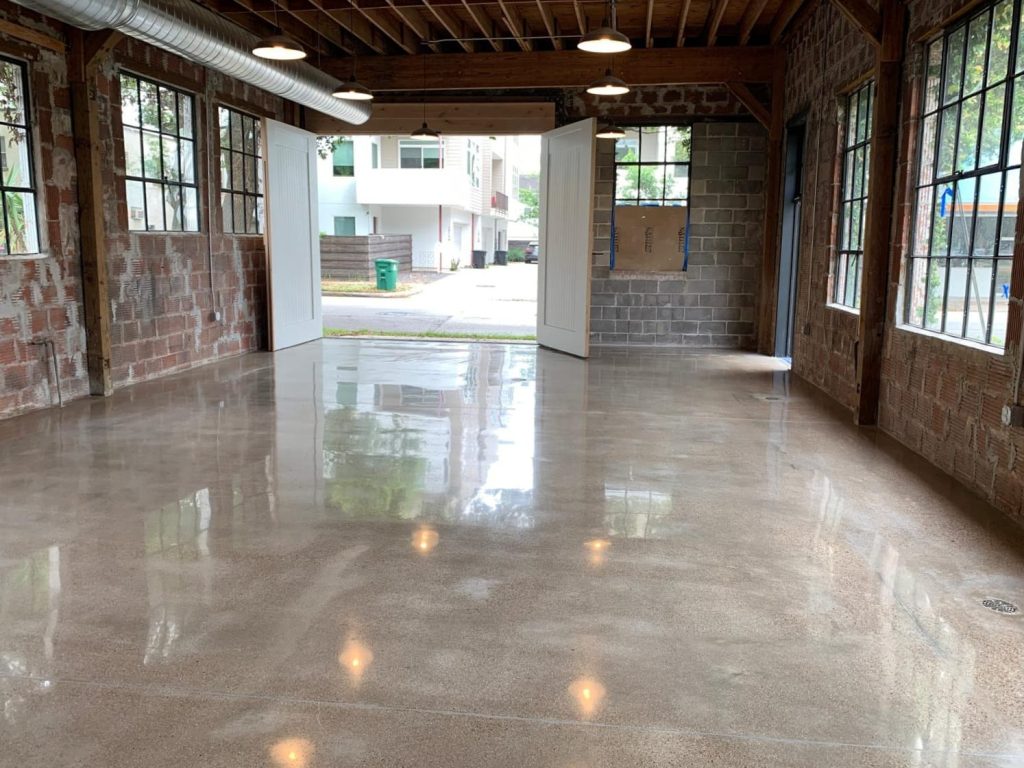
Concrete is a porous material. Even a well-finished slab has a network of capillary pores running through its surface — microscopic channels left behind as water evaporates during the curing process. The surface is also the weakest part of the slab: it carries the highest concentration of calcium hydroxide, a byproduct of cement hydration that is soft, water-soluble, and responsible for the dusting, staining, and premature wear most facility managers accept as inevitable.
Densification addresses this at the source. Rather than sitting on top of the concrete, a good densifier penetrates the surface and reacts chemically with the calcium hydroxide to form calcium silicate hydrate — the same compound responsible for concrete’s structural strength. The surface becomes harder, denser, and more resistant to abrasion from within — not just protected on the outside.
But densification is not a universal preparation step, and applying it in the wrong context can actually work against the system that follows. Understanding what densification does, which type to use, and when it belongs in the process is the kind of knowledge that determines whether a floor system performs for a decade or needs attention in two years.
What Densification Actually Does
When Portland cement hydrates, one of the byproducts is calcium hydroxide (Ca(OH)₂). It accumulates near the surface of the concrete and is one of the main reasons concrete slabs dust, stain, and wear prematurely under traffic and cleaning.
Densifiers work by reacting with this calcium hydroxide to form calcium silicate hydrate (C-S-H) — the same compound responsible for concrete’s inherent strength. This reaction happens within the capillary pore structure of the concrete, filling and hardening it from the inside. The result is a surface zone that is physically harder, less permeable, and chemically more stable.
The practical effects:
● Dusting stops — because the loose calcium hydroxide at the surface has been converted to stable C-S-H
● Abrasion resistance increases — the surface is now genuinely harder, not just coated
● Porosity decreases — the surface becomes more consistent and more receptive to the system going on top
● Polishability improves — densified concrete holds a significantly higher gloss level and maintains it longer
The Main Types of Densifiers
Not all densifiers are formulated the same way. The differences in particle size, reactivity, and chemistry determine how each performs on a given substrate.
Lithium Silicate
Lithium silicate densifiers use the smallest particle size of the silicate family, which allows deeper penetration into the concrete surface. They react quickly and efficiently across a wide range of concrete conditions — including lower-porosity slabs and older concrete — and are less likely to leave whitening or efflorescence on the surface than sodium-based products. Lithium silicate is the most widely specified densifier in professional polished concrete applications for good reason: the results are consistent and predictable.
Sodium Silicate
Sodium silicate was the original concrete densifier technology. The larger particle size means less penetration depth and more surface-level reaction. It performs well on highly porous or softer concrete but can leave a whitish cast on darker surfaces if not applied and cleaned up carefully. Cost-effective for appropriate applications but requires more careful management than lithium-based products.
Colloidal Silica
Colloidal silica uses nano-scale silica particles suspended in solution. Rather than relying solely on reactive chemistry, it fills pores directly with fine silica particles and then reacts with calcium hydroxide at those sites. The result is a particularly dense, smooth surface — which is why colloidal silica is increasingly specified in high-performance polished concrete systems.
Potassium Silicate
Potassium silicate offers a balance between penetration, reactivity, and cost. Its smaller molecular structure allows it to penetrate more effectively than sodium silicate while providing excellent surface hardening and durability on a wide range of concrete substrates. It is less prone to surface whitening or efflorescence than sodium silicate and performs particularly well on porous or medium-density concrete where deeprs chemical reinforcement is desired. Potassium silicate is an excellent choice for densifying concrete prior to polishing or before applying compatible sealers and protective coatings.
High-Solids Formulations
High-solids densifiers — like Coval’s Quantum HS Densifier — deliver a significantly higher concentration of reactive material per gallon than standard formulations. More reactive solids penetrating the surface means a more thorough densification of the surface zone, better abrasion resistance, and a more consistent chemical foundation for the system above. For demanding applications, the performance difference is meaningful.
When Densification Is Required
Polished Concrete Systems
Densification is a non-negotiable step in any properly executed polished concrete system. It is applied during the grinding and polishing process — typically after mechanical refinement has opened up the pores enough to accept the product, and before the fine polishing passes that bring the floor to its finished grit level. Without proper densification, the concrete will not hold the level of polish the specification calls for, and any guard or topical sealer applied above it ii working on a weaker, more variable substrate than it should be.
Guard coat and topical coating applications on polished concrete
Guard coat and topical coating applications on polished concrete Guard coats — reactive hardeners designed to protect a polished concrete surface — require a properly densified substrate. The guard is engineered to bond with a surface that has already been chemically stabilized. Applying a guard over unidentified concrete is one of the most common causes of premature guard failure, uneven sheen, and ongoing maintenance issues.
The same principle applies to topical coatings over polished concrete. Coval’s molecular bonding coatings, for example, perform best when applied to a clean, structurally sound, chemically stable concrete surface. A properly densified substrate minimizes weak cement paste, reduces excessive absorption, and creates a more consistent application profile — which translates directly to more uniform bond consistency, predictable coverage rates, and maximum long-term performance.
Dusty or deteriorating slabs
If a slab is dusting or showing surface deterioration, densification addresses the root cause rather than masking it. It converts the loose calcium hydroxide at the surface into stable C-S-H, stopping the problem at its source.
When Densification Is Not the Right Step
This is where well-intentioned preparation can work against the system.
Many sealer systems — particularly penetrating sealers, breathable sealers, and products that rely on reactive chemistry with the substrate — require a degree of surface porosity to penetrate and bond correctly. Densification closes those pores. Applying a densifier before these systems can prevent the sealer from doing its job.
There is an important exception: polished concrete always requires densification, even when a penetrating sealer is being applied after the polishing process. There are penetrating sealers specifically formulated for polished concrete that are designed to work alongside densifiers — they provide additional protection without relying on surface porosity. If you are sealing polished concrete, densification is still required. The sealer selection is what changes.
The practical rule: the preparation protocol must be matched to the specific coating system being applied. For polished concrete — with any topical coating, guard, or compatible penetrating sealer — densify correctly, at the right stage. For penetrating or reactive sealers applied to unpolished concrete that specify an open surface — do not densify beforehand. Always follow the complete system specification.
Getting the Application Right
Timing in the polishing sequence
Apply the densifier after the concrete has been refined enough that pores are open to accept the product — typically in the 400–800 grit range. Too early and the surface is too inconsistent. Too late and the pores are too closed for effective penetration.
Coverage and wet time
Apply generously and keep the surface wet for the full recommended contact time. The chemical reaction needs time to complete. A thin coat that dries before the reaction finishes produces inconsistent results and misses the depth of hardening the product is capable of delivering.
Even though the floor may feel dry within a few hours, the densifier is still chemically reacting within the concrete. Allowing 24 hours before exposing the surface to traffic or continuing the polishing process gives the reaction time to strengthen and densify the concrete while excess moisture dissipates. This results in a harder, more uniform surface that allows polishing abrasives to cut more consistently, produce better gloss and clarity, and improve long-term durability.
Burnishing and residue removal
After the reaction period, remove any residual densifier left on the surface before excessive buildup is allowed to dry. Light residue can be burnished away with an 800-grit diamond-impregnated pad once the surface is dry, or it can be removed during the next polishing step, provided there is not a heavy buildup remaining on the surface. Excessive dried densifier residue can create an uneven surface, interfere with polishing efficiency, and may affect the adhesion or appearance of subsequent treatments or protective coatings.
Test first
Different concrete mixes, ages, and finishing methods respond differently. Test a small area on unfamiliar concrete before committing to the full floor.
Quantum HS Densifier: The Chemical Foundation for Coval Systems
Coval developed Quantum HS Densifier specifically to serve as the chemical foundation for its concrete protection systems — not as a general-purpose densifier that happens to be compatible, but as Step 1 in an engineered two-step system.
The “HS” designation stands for High Solids. The higher concentration of reactive material delivers deeper penetration, more thorough surface hardening, and a more consistent substrate than standard-solids formulations. It reacts with the free calcium hydroxide in the concrete to create additional C-S-H, permanently increasing surface hardness, reducing porosity, and improving abrasion resistance from within.
Step 1 — Quantum HS Densifier:
Penetrates deep and reacts with free calcium hydroxide to create more C-S-H, strengthening the concrete from within. The result: a harder, denser, more abrasion-resistant substrate with reduced dusting and lower porosity.
Step 2 — Coval Protective Coating:
Molecularly bonds within the densified concrete surface to provide superior resistance to stains, chemicals, UV, and abrasion. Because it is bonding to a properly densified, chemically stable substrate, the covalent bond is more consistent and the system performs as designed.
Together, they address both the internal integrity of the concrete and the external environmental conditions it encounters every day. The densifier strengthens the concrete from within. The Coval coating becomes the protective barrier that preserves that strengthened surface.
Quantum HS Densifier is suitable for industrial floors, polished concrete, commercial, and residential applications — interior and exterior. It is ready to use, low odor, easy to apply, and professionally grade.
A stronger foundation creates a better bond. A better bond creates longer-lasting protection.
To discuss the right preparation and coating system for your project: sales@covaltechnologies.com | 281-566-4277