
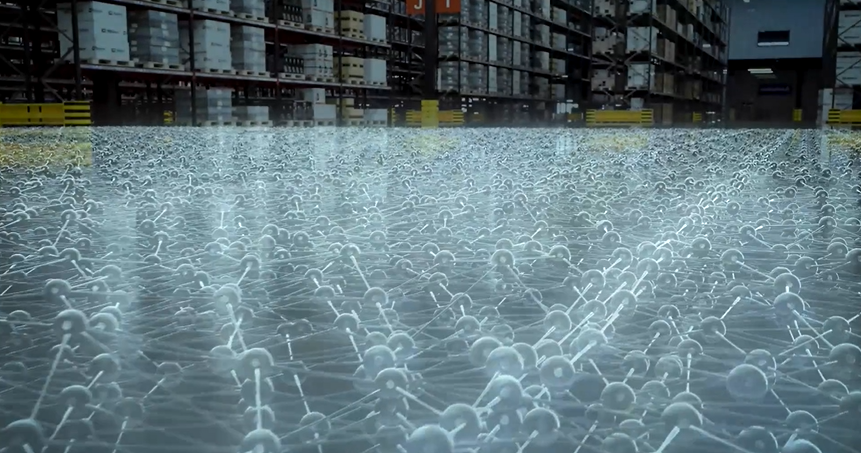
Most coatings fail at the interface — the bond between the coating and the surface beneath it. Not through the coating material itself, and not because the product was deficient. At the point where coating meets substrate is where the failure starts, and understanding why that happens requires understanding how different coatings attach to surfaces in the first place.
Two ways a coating can hold on
Coating adhesion can generally be described in terms of two dominant mechanisms: mechanical attachment and chemical bonding. Most conventional coating systems rely primarily on the first. Coval’s chemistry is engineered to add a chemically bonded component at the coating–substrate interface.
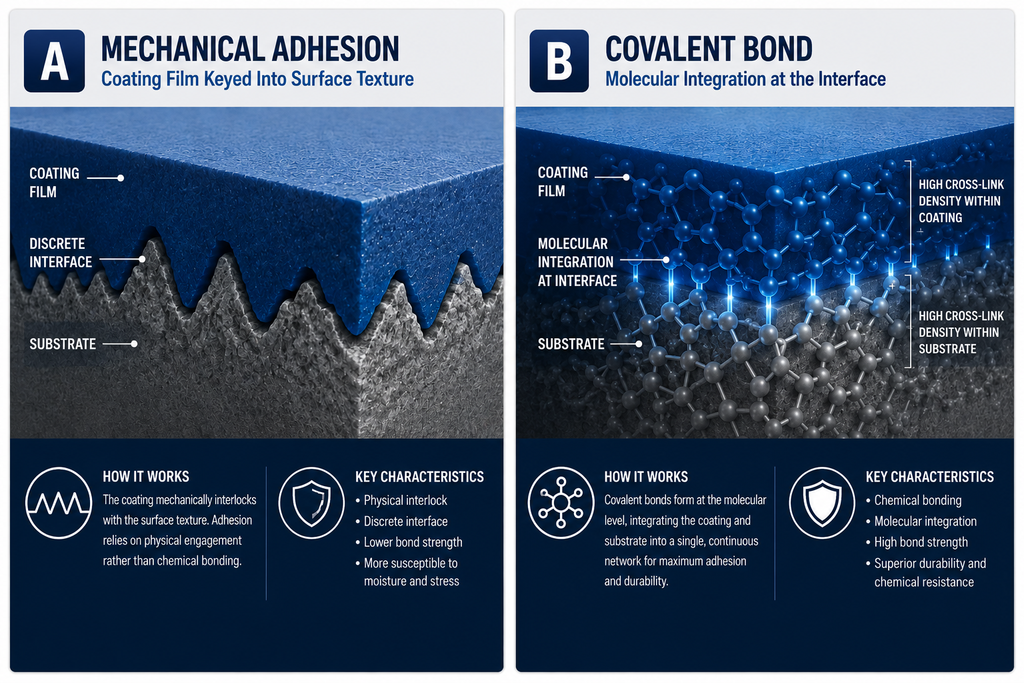
The first is mechanical adhesion. Epoxy, urethane, and many conventional topical coatings rely substantially on this mechanism. The coating flows into the texture and pores of the prepared surface and cures into a film that is physically keyed in place. The bond depends entirely on that surface being correctly prepared: clean, with the right profile, free of contamination. When that preparation is insufficient — wrong surface profile, oil or silicone residue, curing compound still on the slab — the coating has nothing reliable to grip. The interface is compromised before the coating is even fully cured.
This is the primary reason mechanically bonded coatings fail: inadequate surface preparation. The coating material itself may be fine. What failed was the foundation the mechanical grip depended on. Even where prep was done correctly, the interface can be stressed over time by UV exposure, thermal cycling, moisture vapor transmission, or cumulative abrasion — but insufficient prep is where most failures actually originate.
When a mechanically bonded coating lets go, it lets go at the interface: edges lift first, moisture gets behind the film, and delamination spreads. The coating hasn’t failed through its own material. The mechanical grip at the interface — whether weakened by poor prep or degraded over time — simply gave way. The second type of bond works differently. A covalent bond is a chemical bond — atoms sharing electrons to form a connection at the molecular level. When a coating forms covalent bonds with a substrate, it is not gripping a surface. It is chemically integrated with it. The interface is chemically connected rather than relying solely on physical interlocking.
What a covalent bond means in practice
In chemistry, a covalent bond is a strong primary chemical bond formed when atoms share electrons — an intramolecular bond, within a structure, rather than one of the weaker intermolecular forces, such as hydrogen bonding or van der Waals forces, that act between separate molecules. It does not rely on surface texture or mechanical interlock. It forms when reactive groups in the coating chemistry react with compatible groups on the substrate surface, sharing electrons to create bonds that require significant energy to break — far more than the forces that can fail a mechanical grip.
This matters because chemical attachment changes the dominant failure mode. Reduced reliance on mechanical interlocking can reduce the pathways associated with interfacial separation — though moisture management and proper surface preparation remain essential regardless of bonding mechanism.
In practical terms: rather than typically failing through widespread edge-lift and peeling, a properly applied covalently bonded coating is designed to wear more gradually. Wear in high-traffic areas looks different — gradual surface abrasion rather than edge-lift, bubbling, or peeling — and the maintenance response is different as well.
Where Coval sits in this picture — and what makes it different
Coval Technologies takes its name from this chemistry. The name “Coval” derives directly from covalent bonding.
Covalent bonding coatings are not a new product category. There are other products in the market using similar bonding chemistry — polysiloxane-based systems and other molecular bonding formulations among them. The question for any specifier evaluating this category is not simply whether a coating claims covalent bonding, but what the bonding architecture actually delivers.
What distinguishes Coval’s topical coatings within this category is the density of bonding points — both within the coating matrix itself and at the substrate interface. The chemistry is formulated as a hybrid of modified organic resin covalently bonded within inorganic oxides, creating an integrated lattice structure with a significantly higher cross-link density than standard formulations in the same class. More cross-links within the film means the coating is harder and more resistant to abrasion from above. More bonding points at the substrate interface means the attachment is more consistent and more resistant to the forces that can separate a coating from its surface over time.
Coval coatings are topical coatings — they are applied to the surface and provide protection from above, forming a film that resists stains, abrasion, chemicals, and UV. This is not a penetrating sealer. Penetrating sealers work by filling the pores of a substrate — lithium silicate densifiers, for instance, react with calcium hydroxide in the concrete itself to harden it from within. Coval is a topical coating that provides protection from the surface, held in place not by mechanical grip but by molecular attachment at the interface.
In internal comparative testing using ASTM D3363 pencil hardness — the industry-standard method for rating coating film hardness — conventional coatings such as 2K epoxy, 2K polyurethane, and 1K acrylic topped out between H and 2H. Coval coatings reached 9H, the hardest rating the scale measures, a function of the high cross-link density both within the coating and at the substrate interface. Depending on the product and substrate, reactive groups in the coating can form covalent bonds with available surface groups on concrete, stone, metal, tile, or vinyl. Coval is engineered as an integrated system in which both bulk film properties and interfacial chemistry contribute to durability.
What this changes for the customer
First: the maintenance cycle.
When a mechanically bonded coating fails at the interface, remediation typically means full removal — mechanical stripping, re-prep, and reapplication. When a covalently bonded coating wears in high-traffic areas, the protocol is clean and recoat: a fresh coat applied directly over the existing one, no stripping required, because the covalent bond to the substrate is still intact. The surface needs refreshing. The foundation does not.’
Second: the failure mode.
Rather than the edge-lift, bubbling, or catastrophic delamination associated with mechanically bonded coatings, a properly applied Coval system is designed to wear gradually and visibly rather than fail suddenly at the interface.
Third: long-term total cost.
Material cost is rarely the real line item in a coating program. Labor, downtime, and recoating cycles are. A coating system that extends time between recoats — and replaces strip-and-recoat with clean-and-recoat — changes the economics significantly over a facility’s lifetime.
A note on the broader Coval product range
The description above applies specifically to Coval’s topical covalent bond coatings — Concrete Coat, PCS, Stone Coat, UTC, Metal Coat, and related products. Not every product in the Coval system works this way, and the discussion of mechanical adhesion above is not a critique of the underlying approach.
The Coval range also includes primers, densifiers, and sealers that operate through mechanical adhesion, penetration into the substrate, or a combination of both. These products serve specific functions in their own right — surface preparation, substrate reinforcement, penetrating protection — and are appropriate for applications and conditions where a topical covalent bond film is not the right solution. Coval’s Quantum HS Densifier, for instance, penetrates the concrete surface and reacts with calcium hydroxide to permanently harden the slab from within. That is a different mechanism serving a different purpose, and it does so very effectively.
Different substrates, conditions, and performance requirements call for different approaches. The covalent bond topcoat is one answer. The Coval system offers more than one.
To discuss the right coating system for a specific substrate or environment: sales@covaltechnologies.com | USA: +1 281-566-4277 | Singapore: +65 9028 9174 | UAE: +971 54 588 11 77