
Guards vs. Topical Coatings: What the Difference Means for Your Specification
Two products can both be described as “floor protection” and work in entirely different ways. A guard and a topical coating are not interchangeable terms for the same thing, and specifying one where the other is needed produces predictable results: premature wear, appearance problems, and a floor that underperforms against what was specified.
Understanding the distinction — what each product does, how it works, and what it requires — is the foundation of any effective floor protection specification.
What a guard does
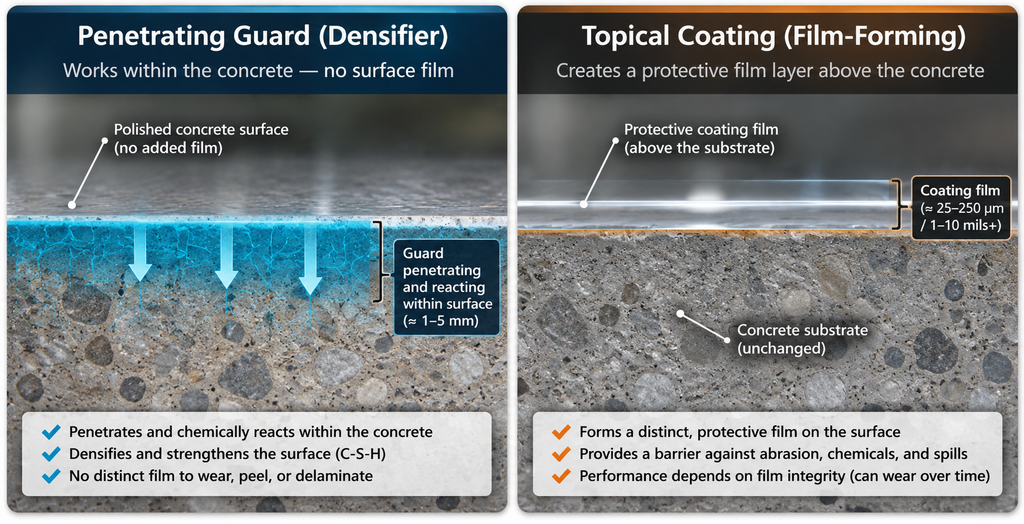
A guard is a reactive product applied to a polished concrete surface that penetrates the top layer of the slab and works at or just below the surface. Rather than forming a distinct protective film above the concrete, a guard chemically interacts with the surface — typically hardening and densifying it, reducing porosity, and improving resistance to staining and abrasion at the surface itself.
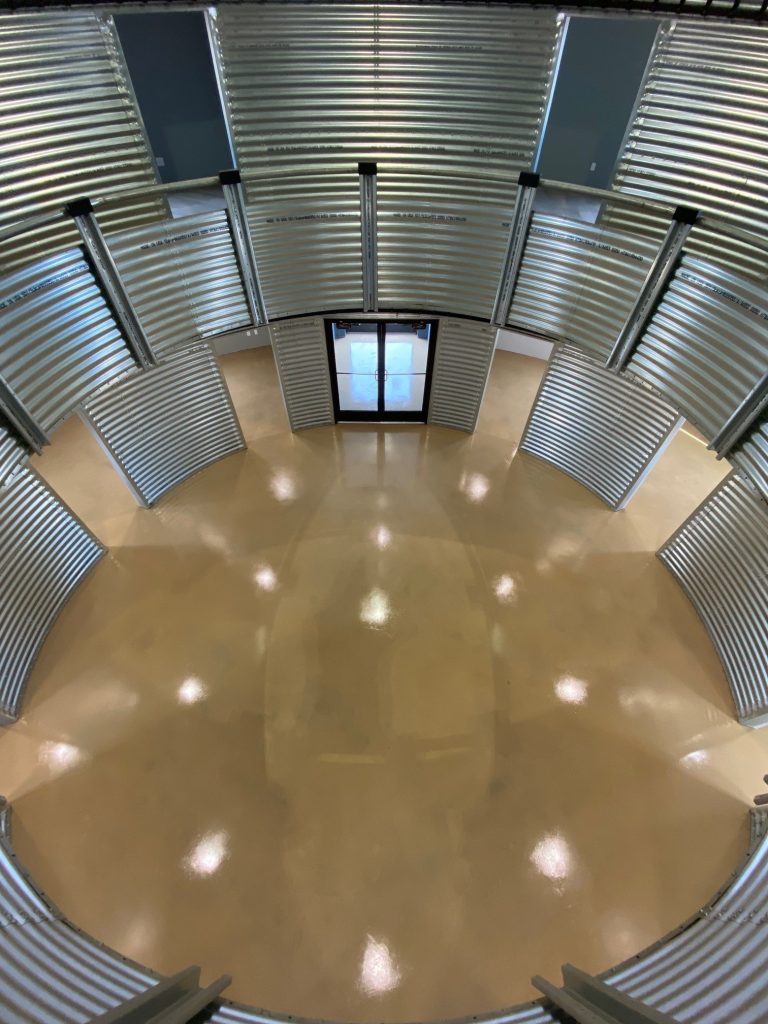
The defining characteristic of a guard is what it does not do: it does not form a visible film. After application and buffing, the concrete looks like polished concrete — the sheen, the depth, the reflection. The protection is in the surface, not above it. There is no coating layer that can be scratched through, peeled at the edges, or visually degraded by surface contact in the way a topical film can be.
Guards are formulated for polished concrete specifically. They depend on a properly densified, well-polished surface to function as designed — the chemistry needs to interact with a surface that has been prepared to receive it. Applied to the wrong substrate, or without the densification step that should precede them, guards cannot deliver their rated performance.
What a topical coating does
A topical coating forms a protective film above the substrate surface. It is applied, cures, and creates a distinct layer that provides the protection — a barrier against staining, abrasion, chemicals, UV exposure, and moisture. The protection comes from the film. The substrate below it is protected because the film intercepts what would otherwise reach it.
The visible result is different from a guard. A topical coating adds a layer — and depending on the formulation, that layer has its own gloss, depth, and appearance characteristics. High-build topical coatings can significantly change the visual character of the surface. Lower-build systems are more transparent. Either way, a film is present, and what you see on the finished floor includes that film.
Topical coatings can be applied to a wider range of substrates than guards: concrete, stone, metal, tile, vinyl, epoxy, urethane, and other previously coated surfaces. The bonding mechanism — whether mechanical adhesion or covalent bonding — determines how the film holds to the substrate and how it performs under the conditions the floor faces.
Why the difference matters at specification stage
The distinction between guard and topical coating is not a technicality. It changes the substrate requirements, the prep protocol, the maintenance approach, and the performance expectations. A specification that confuses the two — or that does not specify which is appropriate — creates the conditions for a floor that will not perform as expected.
Substrate requirements differ.
Guards require polished, densified concrete. The chemistry is designed for that surface. A guard applied to unpolished concrete, or to concrete that has not been densified, will not penetrate or interact with the surface as designed. Topical coatings can go on a broader range of surfaces, but the substrate still has to be correctly prepared — contamination-free, at the right profile, with moisture vapor in a manageable range.
Prep protocols differ.
Because a guard works at the surface, anything in or on that surface that interferes with the chemistry creates a problem. Contamination, residual curing compound, silicone from cleaning products, inadequate polish — any of these affects how the guard interacts with the substrate. Topical coatings require clean, correctly profiled surfaces, but the preparation variables are somewhat different because the product is bonding to (or keying into) the surface rather than penetrating it.
Appearance outcomes differ.
If the specification requires the appearance of polished concrete — the reflectivity, the aggregate show, the depth — a topical coating changes that. A film on top changes the surface. A guard does not, or does so far less noticeably. Conversely, if the specification requires a specific gloss level, color consistency, or the visual character of a coated surface, a guard applied to polished concrete is not going to deliver it.
Maintenance protocols differ.
Guards and topical coatings wear differently and are maintained differently. A guard that has worn in high-traffic areas typically requires reapplication — often with re-polishing to bring the surface back to the right condition. A topical coating that has worn at the surface can generally be recoated without stripping, provided the base film and bond to the substrate are intact. The maintenance model is part of the specification decision.
Where Coval products sit in this picture
The Coval range includes products that operate on both sides of this distinction, and understanding which product belongs in which category is essential to accurate specification.
Coval PCS (Polished Concrete Sealer)
Designed specifically for highly polished, densified concrete surfaces. PCS provides protection without the visual character of a full topical film — it is formulated for the polished concrete context, where maintaining the surface appearance is a requirement and where the substrate has been properly prepared through densification and polishing.
Coval UTC (Ultimate Top Coat)
A topical coating designed to go over a range of previously coated or prepared substrates: epoxy, urethane, terrazzo, ceramic and porcelain tile, and polished concrete. UTC forms a protective film using Coval’s covalent bonding chemistry, delivering 9H pencil hardness (ASTM D3363) in internal comparative testing. It is the appropriate product when the performance requirements call for a film-forming topical coating rather than a guard-style surface treatment.
Coval Concrete Coat
Decorative and industrial concrete floors, masonry, precast, and terrazzo. A topical coating that bonds covalently to the substrate, forming a hard, protective film. Appropriate when the substrate is concrete but the requirement is for a topical protective layer rather than a polished-concrete guard application.
The distinction between guard and topical in Coval’s range reflects a broader principle: the right product is determined by the substrate, the prep protocol, the performance requirements, and the appearance outcome — not by a single product category label. Two products can both carry the Coval name and work in fundamentally different ways, because different surfaces and different performance needs require different approaches.
The specification question
Before specifying any floor protection product — guard or topical — the following questions should be answered:
What is the substrate, and what condition is it in?
Polished concrete calls for a different product than unpolished concrete, and both call for different products than tile, stone, or metal. The substrate determines which products are applicable.
What preparation has been done, and what is planned?
A guard requires densified, polished concrete. A topical coating requires a clean, correctly profiled, adequately prepared surface. If the prep protocol and the product selection are not aligned, the specification is incomplete.
What appearance outcome is required?
If maintaining the look of polished concrete is essential, a guard is the right direction. If the specification calls for a specific gloss level, enhanced color depth, or the visual character of a coated surface, a topical coating is appropriate.
What performance is required, and in what conditions?
Chemical exposure, UV, heavy traffic, moisture, temperature cycling — the conditions the floor will face determine which product chemistry is appropriate and what performance level is required.
What does the maintenance model look like?
A guard and a topical coating have different recoat protocols and different maintenance requirements. The long-term maintenance model should be part of the specification decision, not an afterthought.
The answer to these questions determines the product. Starting with the product and working backward is the pattern most likely to produce a floor that underperforms against what was specified.
This is the final post in our Science of Protection series. Starting next week, we move into the Decision Framework series — practical guidance for translating surface conditions, performance requirements, and maintenance models into accurate specifications.
To discuss system selection or specification for a specific project: sales@covaltechnologies.com | USA: +1 281-566-4277 | Singapore: +65 9028 9174 | UAE: +971 54 588 11 77